


Beer: positive aspects
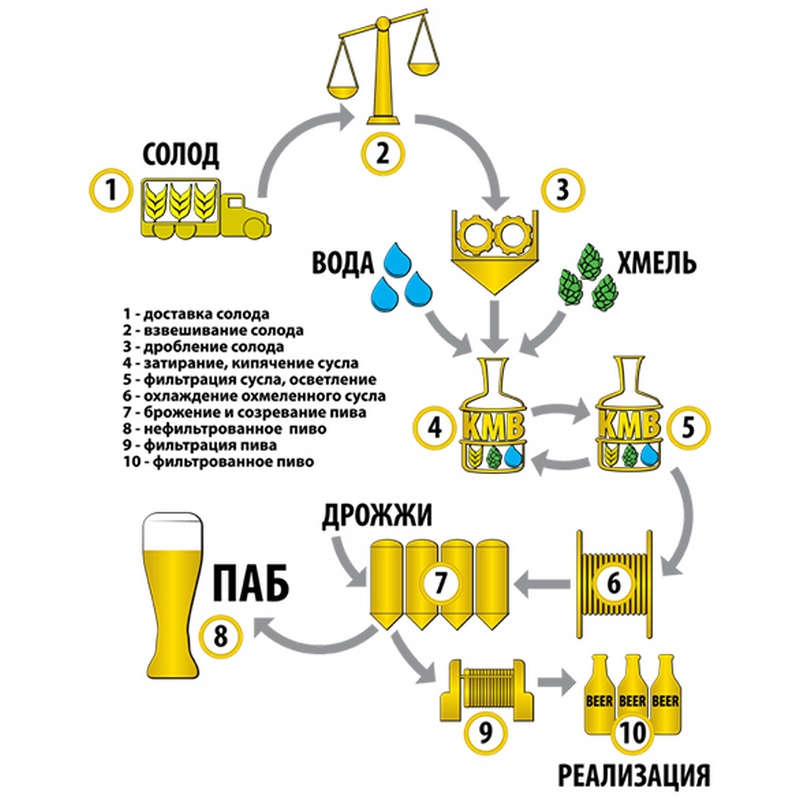
We believe that drinking beer is much more enjoyable when you know how it is made. That is why we are providing a brief overview of beer production technology.
The production technology includes the following stages:
Malt counterfeiting – germination of cereal grains, most often barley, drying and cleaning from sprouts. During germination, the starch in the grains is broken down into sugars. Different degrees of drying (roasting) of malt are used to make different types of beer - light, dark, black. The more the malt is dried, the more the sugars in it caramelize.
Mashing the wort – malt is crushed and mixed with water. The wort acquires a sweetish taste. Mash is a mixture of crushed grain products intended for mashing with water.
During mashing, gradual heating is carried out with the so-called "temperature pauses" necessary for the action of various enzymes. In modern production, there are several such pauses. 50-52 degrees for 10-15 minutes (protein pause, for protein breakdown), 62-63 degrees for 30-40 minutes (maltose pause, the beta-amylase enzyme acts, which grinds starch into large fragments), 70-72 degrees for 10-15 minutes (saccharification, alpha-amylase acts, which grinds dextrins into smaller fragments - oligosaccharides, maltose). The end of the saccharification process is determined by iodine test (iodine drops should not turn blue). Then the mash is heated to 78 degrees (to inactivate enzymes and reduce viscosity) and submitted for filtration. There are technologies for mashing with decoctions, when part of the mash boils. This method is usually used when using unsweetened raw materials - barley, rice, corn, as well as in the production of dark beers.
Filtration of mash — the mash is pumped into a filter vat, where it is separated into unhopped wort and grains. Grains are insoluble barley residues obtained during the mash filtration process.
Filtration consists of two stages. In the first, the free-flowing wort is selected, in the second, the grains are washed with hot water. Both portions are mixed in a wort boiler. Thus, the grains serve as a filter partition. Filter presses are also used, in which the role of the filter partition is played by a synthetic material, and filtration occurs not under the influence of gravity, but by pneumatic compression of the filter elements.
Boiling the wort — the wort with the addition of hops, as well as other ingredients, is boiled for 1-2 hours. During boiling, the hops dissolve, protein substances coagulate and precipitate. In addition, various aromatic components evaporate, which adversely affect the taste of beer.
Wort clarification — the wort is pumped into a vortex bath (whirlpool) to separate the insoluble residues of barley and hops. These particles, under the action of the friction force of the liquid layers, are collected in the center of the bottom of the hydrocyclone. After 20-30 minutes of settling, the wort is separated from the insoluble residue - the mash (pipe).
Cooling and aeration of wort — the wort is pumped into the fermentation tank. During pumping, it cools and is saturated with oxygen, which is necessary for yeast reproduction.
Fermentation — the simplest sugars contained in the wort are converted into alcohol and carbon dioxide by yeast. The duration (no more than one week) and the temperature of the process depend on what kind of beer they want to get — ale or lager (from the German "lagern" "to store, to withstand"). The product obtained at this stage — the so-called young beer — is then placed in the lager department tanks for maturation.
The purpose of maturation — improvement of the organoleptic properties of the drink, cleavage of diacetyl and esters.
CCTs are widely used - cylindrically-conical tanks, in which the processes of primary fermentation and maturation occur continuously, without pumping, in one container.
Filtration — beer is filtered from yeast residues. Filtration is commonly used in industrial brewing. Some filtration methods destroy the microflora of beer and thereby increase its shelf life. Washable diatomaceous earth filters, ceramic filters, filter presses, and separators are used.
Pasteurization — some beers are pasteurized — heated to a temperature of about 68-72 °C — to increase shelf life. Pasteurization is believed to worsen the taste of the drink.
Similar events


