


Beer: positive aspects
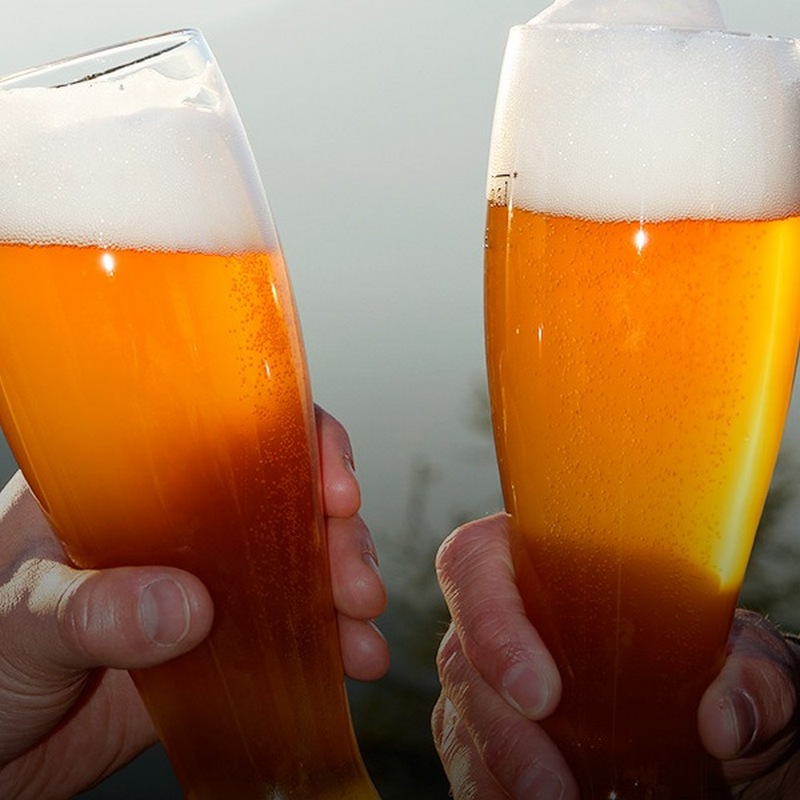
Beer foam
Foam is the hallmark of beer. It can be used to determine the quality of the drink. If the foam is thin, with a lot of bubbles, red, and unsightly, then this beer is not first-class. The foam of good beer is compact and monolithic, without bubbles and completely white. Pour the beer into a large glass or tumbler. Excellent beer should have a foam height of at least 4 cm and keep it for at least 4 minutes. If the foam is lower or disappears without a trace in a shorter period of time, it means that it is not quite excellent. Try blowing lightly on the foam. If the foam disappears, then the beer is bad, if it «bends», then it is good. And one more tip. Place a coin on top of the foam layer. It does not sink – another indicator of good quality. In addition, the foam should «stick» to the walls. If after you drink beer, traces of foam remain on the walls of the glass, everything is fine - you drank beer. If there are no traces, then you should think about whether this is really real beer.
Beer color
Beer is divided into dark and light. But almost any brand of beer has its own shade. The European Brewers Convention (EBC) uses special standards to assess the color of beer - 9 glass discs of different shades. Our experts dilute iodine in water until they get a shade close to the color of beer, and determine the color by the specific gravity of iodine. In the concept of "color" not only the characteristic shade is important, but also transparency, the presence or absence of a color scheme. The strictest requirements are imposed on light beer. Its color scheme should be clean, transparent, golden. It should not have a reddish, brown or greenish tint. And also - it should sparkle. But dark beer may not sparkle, be brown or even not be transparent. And at the same time remain beer. But no professional will be able to determine by color whether it is good.
The smell of beer
However, the most important thing in evaluating beer is not vision, but smell. When we taste beer, we perceive it not with our tongue, but mainly with our nose, when we inhale and exhale the aroma of the tasted drink. The explanation is simple: the human sense of smell is much more multifaceted and sensitive than taste. If you want to evaluate the quality of beer by smell, you must determine how harmonious the combination of all the smells that you inhale and exhale, smelling the beer and tasting it. When characterizing smells, the following concepts are used: hoppy, clean, fresh, weak hoppy, yeasty, floral, spoiled beer (sour, rotten).
By the way
The organ of smell is not the nose itself - it is only a channel for air access to the olfactory mucous membrane. It is very small, so when breathing, only a very small amount of odors is caught. If you want to catch the smell more perceptibly, you should inhale several times successively through the nose, exhaling through the mouth. But we inhale smells even when we drink beer: the movement of the drink in the oral cavity also directs the aromas to the olfactory membrane. This same membrane also perceives the odors that the mucous membrane of the mouth has absorbed and that we feel when we have already swallowed beer. The greatest perception of smell, by the way, is manifested at the moment when we finish swallowing. Try to "smell" beer like this - pleasant sensations mean that the beer you drink is good, and if you like the smell, then this is your beer.
The taste of beer
There are only four basic taste sensations: sweet, bitter, sour, salty. However, most brands of beer contain all four tastes in various combinations. And the concept of «tasty beer» consists of a complex sensation of all four, and the sensation is not instantaneous, but stretched out in time. The sequential transition from sweet to sour, salty and bitter should give pleasant sensations, as well as the overall aftertaste, when all four groups of taste buds work. The slightest dissonance - and the beauty of the taste disappears. When tasting beer «by taste», we use our tongue, cheeks, palate, lips. However, only the tongue gives us an idea of the taste - the lips, cheeks, palate can give us only tactile and thermal ideas about the drink. And this is not small: temperature, consistency, viscosity, astringency, oiliness - all this is felt by the oral cavity, the tongue does not participate in this.
Pale beer should be dominated by a subtle hop bitterness – extractives should be almost imperceptible. After drinking, pale beer should leave a quickly disappearing taste of hop bitterness on the tongue. Good pale beer has practically no aftertaste. High-quality pale beer is characterized by such taste terms as «clean», «full», “harmonious”, «expressed».
Dark beer, on the contrary, should be sweet and not leave a hop bitterness - its taste is fuller, as a result of which the beer seems more "dense". After drinking, dark beer should leave only the taste of malt, without a bitter aftertaste. The taste of a good dark beer is characterized as "weakly pronounced", "empty", "malty", "sweetish".
A very important characteristic of beer is not only the taste, but also the aftertaste, that is, the aftertaste that remains in the mouth for some time after the drink is swallowed. By the way, a long feeling of bitterness in the aftertaste indicates a low quality of beer, since it is caused by the low quality of the products used in the preparation of beer or a violation of the technology.
Similar events


